Sunday, March 4, 2012

Photo Challenge: Barber cuts in

Elvis cuts in 2012© Keri Neal
After viewing the movie, "Roman Holiday" I was inspired by a scene where the characters are attending an outdoor dance and a local Barber cuts in while the two lead characters are dancing. Not to be rude, but rather to join in the festivities and, naturally, to woo the attention of the pretty girl.
Here. I took this image when a Flash-mob broke out in the square at Trivolli Village in Las Vegas. The dance group (including the show girl) that practiced the choreography were pleasantly surprised when Elvis, popped in.
I found this to be newsworthy for several reasons; the flash-mob itself, is always a surprise of spreading joy, the location is a newly opened shopping center in town - the event to celebrate the Grand Opening, and anytime Elvis makes an appearance it is newsworthy.
I took this photo using my "drop" camera; a Canon Rebel on f/16 @1/500 sec with a 75-300mm lens.  It was hard to hold still with all the excitement around me.
Rock on, Elvis, rock on.

Monday, February 27, 2012

Is she fair game?

After watching the movie Roman Holiday, starring Audrey Hepburn (Princess Anna), Gregory Peck (Writer; Joe Brady) and Eddie Albert (Photographer; Irvin), they are faced with a dilemma of to publish or not to publicize the quirk events surrounding a Princess.  The statement is made; " ...She is fair game..." implying they (the two male characters) should go forward and publish the Princess' activities.
   When posed with the question of Is she fair game? First we must define just what fair game is. My definition would be, when speaking of a girl, does she have a ring on her finger? If not, she is fair game. In other words, if a lady has not been betrothed to another, than she is fair game.
    With reference to the movie and the issue of printing the story & photographers; I would have to reply... Heck Yeh! After all, the Princess is a public figure. Her image in a public place is completely "fair game" based on those factors alone. Now, the movie is a romance, so Gregory Peck goes soft and decides to not go forward and write the story.  Not only is he out the five grand for his exclusive, he does not get the girl either.  FOOL!
   In conclusion - fair game has a broad definition as a whole, but may be interrupted very specifically when it comes to photography, especially when the image is captured of a public figure, in public.

Saturday, February 25, 2012

Photo Challenge: How do you show the light reflection on eyes?

2012© KeriNeal dba KeriLynn Design, LLC
Reflection - inner, exterior of one self or of something. What or who is being reflected? And most importantly, do the eyes tell all?
Or is it what is reflected in the eyes that tells the true story?
In a painting, the light reflection is a white dab of pigment. In a photograph, all will be revealed through the final processing and development.A person in the middle, with lights all around creating the highlight of the pupil.
Here is photograph I took of myself inside the pupil of a friend. I did this with a Canon 7D with a portrait 85-135mm lens. Focusing just on my reflection, I pushed an f8 with a speed of 1/160.
The squiggly colors behind me, where a happy accident from the blinking street signs and evening sun.

Monday, February 20, 2012

Biggest challenge to complete my business plan

I must admit, I have a current active business plan, so ask me what is my biggest challenge in creating a business plan is moot. HOWEVER~ some challenges I face day in and day out is following my plan, altering my plan and adjusting to the ever changing environment of photography and my current economical atmosphere. When creating my Executive Summary, one of the hardest things to do is talk about yourself, sell yourself and by all means, toot your own horn. I fall short in doing this. I can talk about my business, my passion, all day long with those that share the passion; but to discuss with a room of bankers, who probably don't speak the same jargon, is terrifying.

Although the executive summary leads off the business plan, it should be written last. That way, you can gather information from the rest of the report, and make certain there are no inconsistencies.
The executive summary is the best place to illustrate your mission statement. Develop a brief description, no more than a few sentences, which explain:
  • Why your business exists
  • What its goals are
  • How you will achieve those goals
“…your plans must incorporate the idea that the business of photography is constantly changing. You not only must plan for what you expect, but you must establish responses to unexpected events and response to those responses, and so on and so on.” (Best Business Practices for Photographers; John Harrington, pg 7)
Next, develop the business concept; details about the type of business you want to open, who the customers will be and what the competitive advantage is. A competitive advantage explains why customers will chose your business over marketplace rivals. Your reasons may include:
  • Filling a void in the marketplace
  • Offering a better product than what currently exists
  • Offering a comparable product, but at a better price than your rivals
From there, give a brief description of your financial stance. This part of the executive summary should mention the expected start up costs, as well as your short and long term financial projections.
“Statistics show that an invoice more than 60 days old has only a 70% chance of being collected in full. After 90 days, the chance of collecting the invoice in full drops to 45% and after 120 days it falls to 20% It diminishes form there, so make sure you get paid sooner than later.” (Best Business Practices for Photographers; John Harrington, pg 365)
The next issue to address is your business status. It may still be only in the idea stage. Perhaps you've already raised a little money. Or, it may be that you are fully operational and looking to expand. Investors will interpret your current business position as a signal as to how much capital is needed to advance your company, and whether or not this equals the type of opportunity they are looking for.
The final part of the executive summary will focus on critical aspects that will determine your chance for success. These items will be specific to your business, but may include:
  • Low staff turnover
  • A technology patent
  • A strategic partnership
  • Externalizations, such as the continuation of a marketplace or economic trend
“If you have been telling yourself that you can’t cause for your success to happen, then you are a victim, but not a victim of circumstance, a victim of your own thinking.” (9 Lies That Are Holding Your Business Back...and the Truth That Will Set It Free; Steve Chandler & Sam Beckford, Career Press, 2005 Pg. 163)
Generally, the executive summary should offer a glance into what the business plan holds. Highlight the important points; if you refrain from composing it until after you've written the rest of your business plan, it should virtually write itself.

Sunday, February 19, 2012

Photo Challenge: Paparazzo Style

2012© KeriNeal dba KeriLynn Design, LLC
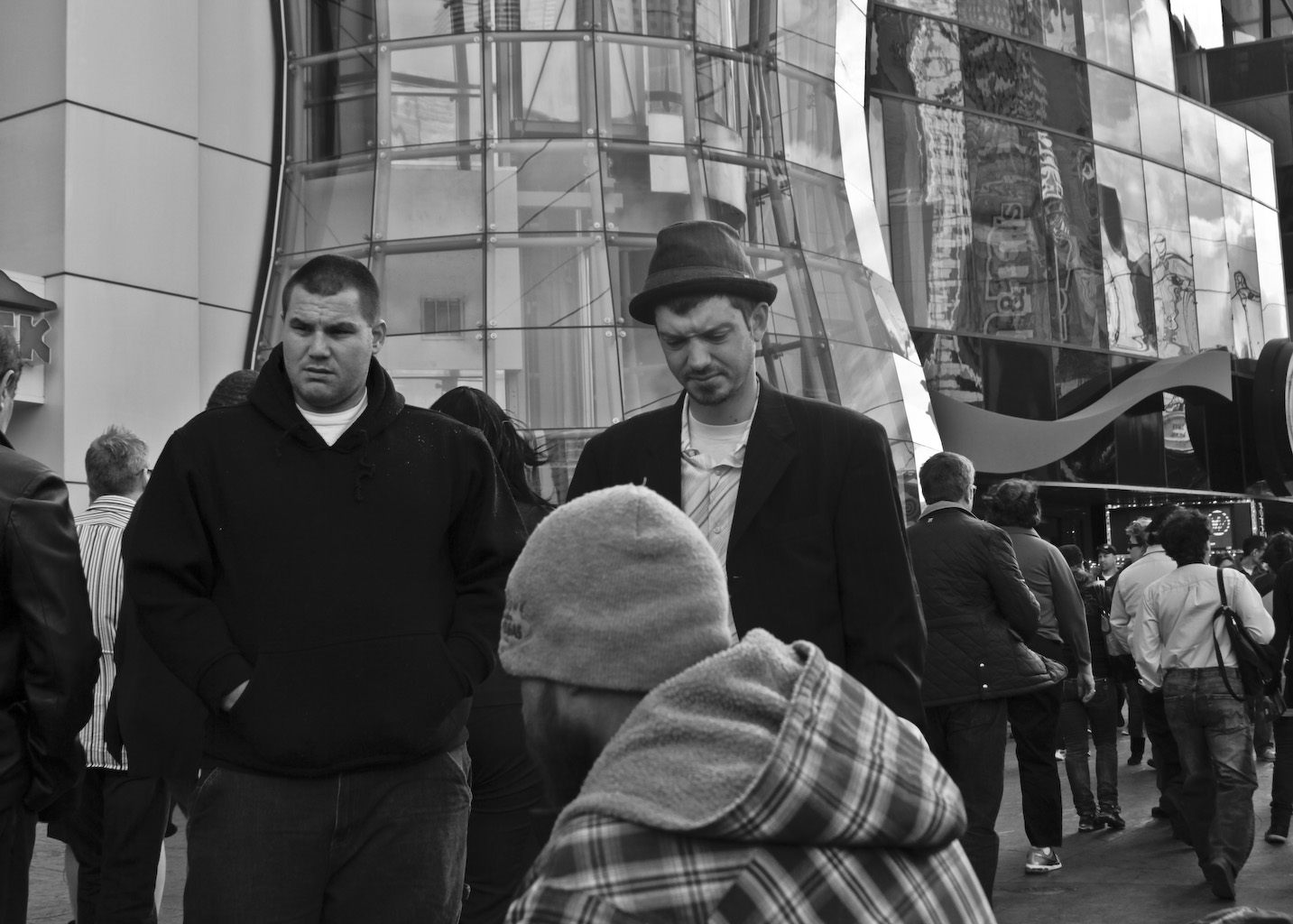
In the style of the great Ron Galello, I was hunting on the streets of Las Vegas Strip hoping to come across a celebrity. I spotted this guy and his buddy, dodging and weaving through the crowd, as if the were important.  As he came into my frame, he had a scowl on his face. His mannerisms and his scoff as he spotted me with my camera, easily made a great target for this shot, I can almost see a disgusted Marlon Brando attitude in him. I am so grateful he did not reach out and break my jaw.
I shot this image with a Canon 7D with a 135mm lens at a fast rate of speed. I wanted to ensure getting his photo before he passed me. The expression I captured was a bonus of being in the right p[lace at the right time.

Monday, February 13, 2012

Ron Galella & the 1st Amendment

Prior to the intrusive, aggressive paparazzi of today, there was Ron Galella, a photographer who made history. Smash His Camera is a documentary about the life and career of Ron Galella, the man who fundamentally gave birth to the stalking methods of today’s paparazzi. Galella cultivated fame in the 1970s and 1980s. For over ten years he set his sights on Jacqueline Kennedy Onassis, although he also photographed any other celebrity he could find.
Galella has a list of dos and don’ts for students in the art of paparazzi. His first rule is to sneak in. He also advises photographers to dress the part, know where the kitchen is as that is an easy access point, forge credentials, and shoot fast. He enjoyed capturing surprised expressions of his subjects.

The ironic circumstance is he can get away this, simply because he is shooting celebrity figures; the legal term is public figures. When shooting a citizen who is not a public figure, a photographer should always obtain a signed release. Whether it is for location, property, or person, this release gives the photographer the permission to use these photographs as they see fit with regards to reproduction, publication, printing and distribution.
A model release being the most common, and it is executed by anyone over the age of 18. Or in rare cases, the person, signing the release could be deemed to be a legal guardian if the subjects considered not capable of executing a release.(John Harrington; Best Business Practices For Photographers, Pg. 344)

Failure to get these signed releases can result in a messy law suit. however, what if you are a paparazzi photographer and the public figure you are chasing down feels you are stalking them? Well, in all reality, you are. So how do you deal with this? How does the 1st Amendment address this? First let's look into the details of Ron Gallella's case:

Ron Galella vs. Jacqueline Kennedy Onassis

“I do not have any guilt,” he says about what he has done through the years. Yet he was in a famous court battle with Jacqueline Kennedy Onassis. Galella followed Jackie and her kids all around New York City. Jackie once asked her bodyguards to “smash his camera.” Galella sued Jackie O who counter-sued Galella. The First Amendment rights were on the table as personal privacy went up against freedom of the press and free speech. Jackie’s attorney’s argued that Galella’s tactics worried Mrs. Onassis and frightened her two young children, who were under the age of 18, therefore still under the protection of the Secret Service. (Prime Time TV, Francine Brokaw, May 30, 2010)
It would appear that Jackie O feels she is not a public figure and should have the same 1st Amendment protection as any other citizen, but this is not the case. She is a high profile public figure (especially at the time of this case) and has to accept that she will be a highly desired subject to photograph.
Ron Galella ran into a similar situation from Marlon Brando.  While walking down the street with Dick Cavett, after a taping of a 1973 show, they were met face to face with Ron's camera. After several dozen images, and a few blocks, Marlon became irritated and literally cold coked Ron and broke his jaw. Yes, they went to court, but as Ron says, "It was never about the money" he just wanted celebrities to understand, they are public figures making their daily life a desired community to the photographic community.
So, the next time you are shooting on a public street and Mathew McConaughey walks in front of your lens, SNAP AWAY. you are protected under the 1st Amendment to do so, just be smart and don't piss him off, or you may be looking at a trip to the E.R. or worse, dental surgery.


Friday, February 10, 2012

Photo Challenge: Light Play

"Tunnel Vision" 2012© KeriNeal dba KeriLynn Design, LLC
Pueblo Picasso, although not the first artist to do light play, made the process popular with his works.
Here is my version of light play.
I made this by setting steel wool on fire. WHAT? Yes, it can be a flammable product. By spreading the steel wool, allowing air to pass through it, then placing it inside an old metal whisk, then attaching it with a toggle to a cable, I lit the steel wool. Then I began twirling it around me, in a circular pattern, be aware of every movement I made. The steel wool burns out in about :30 seconds, so you do need to work rather quickly. However, :30 seconds in shutter speed time is slow. Please note: SAFETY FIRST! I covered my exposed skin with hats, gloves, bandana over my face and had a jug of water with me. Also, I chose the cement flood tunnels for safety reasons and knew it would contain, allowing for a higher concentration of the light and sparks.
I shot this with a Canon 7D on a long exposure rate of BULB, ISO 100, standard 18mm-55mm lens and using my wireless remote.
Not only was this project fun, it gave my creative mind an opportunity to work in overdrive. Loved it!